
Our Office
-
710, A-Wing, Centrum Business Square, Road No. 16
-
Wagle Estate, Thane (West) 400604, Maharashtra.
Rapid. Robust. Real.
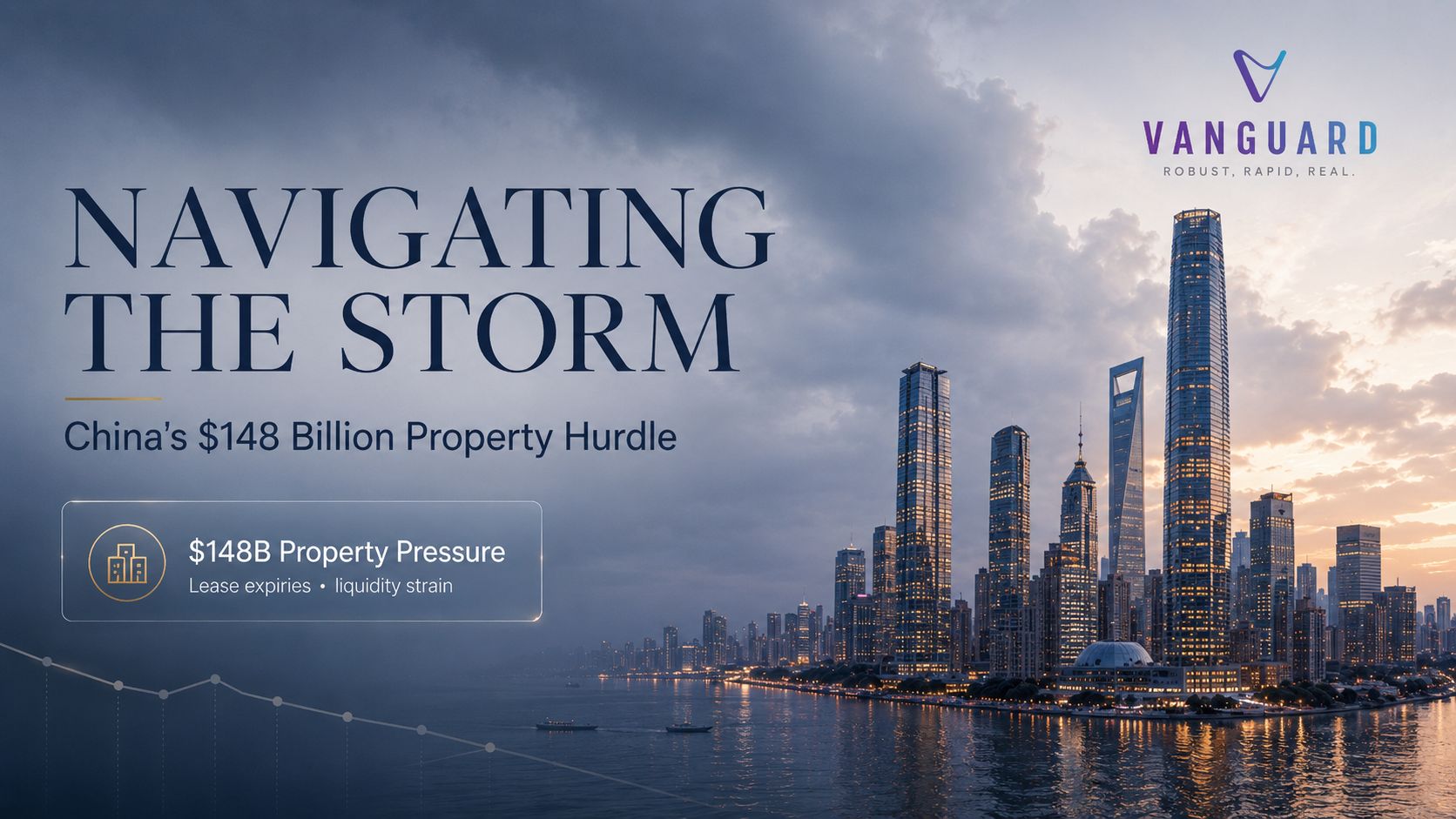
The global real estate market is keeping a watchful eye on the East. The Chinese real estate sector, long relied upon as a primary engine for domestic economic growth, continues to grapple with deep-rooted systemic challenges.
Just as the market attempts to stabilise from previous liquidity crises, a new catalyst has emerged, threatening to test the resilience of developers and investors alike: a looming $148 billion hurdle tied to expiring property and land leases.
At Vanguard Ventures, we continuously monitor macroeconomic pressure points to better position our portfolios and advise our partners. This developing situation is not just a China-specific concern. It is a reminder of how land structures, liquidity cycles, investor confidence, and policy response can reshape real estate markets at scale.
China’s $148 billion property hurdle is more than a lease-expiry issue. It is a stress test for liquidity, regulation, and investor confidence in one of the world’s most closely watched real estate markets.
To understand the magnitude of this hurdle, one must first understand the structure of Chinese real estate. In China, urban land is owned by the state, and developers or homeowners purchase usage rights for a set period, typically ranging from 40 to 70 years depending on the property type.
This month, a massive wave of these land and property leases are approaching their expiration dates. Cumulatively, the market is racing to address $148 billion worth of expiring assets.
In a robust economic climate, lease renewals or asset restructuring can be handled with standard refinancing. However, in an ecosystem currently starved for liquidity, this creates a severe financial bottleneck. Developers, investors, creditors, and local authorities are now being forced to find solutions within a market already under significant pressure.
| Pressure Point | Current Challenge | What It Signals |
|---|---|---|
| Expiring Property & Land Leases | $148 billion hurdle | A major wave of assets requires renewal, refinancing, or restructuring |
| Land Ownership Structure | State-owned urban land | Developers and homeowners rely on fixed-period usage rights |
| Usage Rights Tenure | 40 to 70 years | Different asset classes face different renewal and restructuring timelines |
| Market Liquidity | Constrained capital access | Refinancing and restructuring become harder in a stressed market |
| Investor Confidence | Fragile sentiment | The outcome could influence broader global real estate risk perception |
This expiration wave is not happening in a vacuum. It arrives at a time when the domestic property market continues to face immense headwinds. For developers already dealing with tighter financing, slower sales velocity, and cautious buyer sentiment, the lease-expiry challenge adds another layer of complexity.
Traditional avenues for financing remain tight, making it exceptionally difficult for developers to raise the capital required to renew leases or execute standard restructurings. When liquidity is limited, even manageable obligations can become serious pressure points.
Domestic buyer confidence has cooled, which means developers cannot rely on rapid pre-sales to generate the immediate cash flow needed to cover these looming $148 billion obligations. In real estate, confidence is not just an emotional factor. It directly affects liquidity, absorption, and project continuity.
Investors and developers are now forced to rapidly navigate complex restructuring agreements with local municipalities and creditors before the clock runs out. The challenge is not only financial. It is also regulatory, operational, and deeply tied to market perception.
When lease timelines, liquidity stress, and weak buyer confidence converge, the real estate market enters a phase where speed, negotiation strength, and policy clarity become critical.
When systemic challenges arise, reactive capital flees, but strategic capital pays attention. At Vanguard Ventures, we view this $148 billion hurdle through a dual lens: macro risk management and generational restructuring opportunities.
For global investors with indirect exposure to Chinese real estate debt, this is a moment to stress-test portfolios. The restructuring of these assets will likely result in further consolidations, and stakeholders must be prepared for potential write-downs on distressed assets.
This is where disciplined portfolio review becomes essential. Exposure does not always appear directly. It can exist through funds, credit structures, development-linked instruments, or broader market sentiment. Investors who understand these linkages early are better positioned to manage downside risk.
Systemic pressure often forces regulatory innovation and opens doors for well-capitalised, institutional players. As distressed developers look to offload assets or seek joint-venture lifelines to manage their expiring leases, there may be unique opportunities for distressed-asset investors who possess deep local expertise and the patience to navigate the regulatory landscape.
However, opportunity in a stressed market is never simple. It requires legal clarity, capital patience, policy understanding, and a realistic view of asset quality. The strongest investors are not the ones who simply chase distress. They are the ones who understand which distressed assets can be transformed into long-term value.
Risk and opportunity often appear together in real estate. The difference lies in preparation, timing, capital strength, and the ability to read structural shifts before they become obvious.
The $148 billion question is no longer just about how these specific leases will be restructured. It is a litmus test for how the Chinese real estate sector manages systemic de-leveraging.
The outcome will matter beyond China. Global investors are watching how policymakers, developers, creditors, and municipalities respond to this pressure. A controlled restructuring path could restore some confidence over time, while prolonged uncertainty may deepen caution around real estate-linked exposure.
For India and other growing property markets, the lesson is clear: real estate strength is built not only on demand, but also on transparent structures, disciplined leverage, strong buyer confidence, and long-term policy stability.
China’s property hurdle shows how quickly structural pressure can become a market-wide concern when liquidity weakens. The issue may begin with expiring leases, but its impact reaches financing, investor sentiment, asset valuation, and broader confidence in real estate as an investment class.
At Vanguard Ventures, we believe global real estate shifts must be studied carefully because they often reveal deeper lessons about risk, resilience, and opportunity.
To discuss how global real estate shifts may impact your investment strategy, connect with the Vanguard Ventures advisory team today.
In uncertain markets, the advantage belongs to those who do not just react to the storm, but understand the forces creating it.