Our Office
-
710, A-Wing, Centrum Business Square, Road No. 16
-
Wagle Estate, Thane (West) 400604, Maharashtra.
Rapid. Robust. Real.
In real estate, a project launch is not just an announcement.
It is the moment the market starts forming an opinion.
And quietly, without the developer even realising it, the project starts getting labelled.
That label matters.
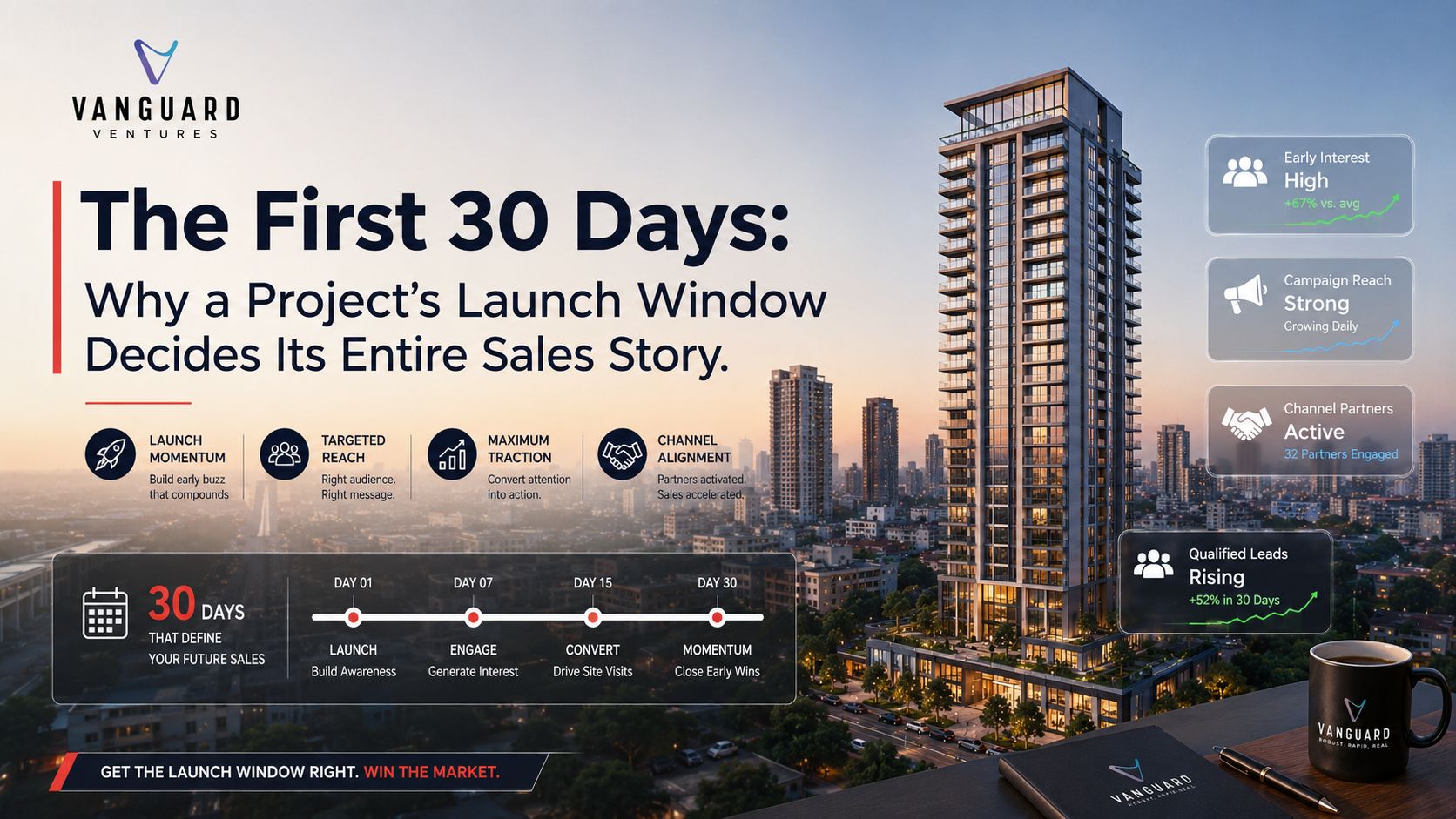
Because in real estate, the first 30 days of a launch often decide how the market will treat the project for the next several months.
A strong launch window creates confidence, urgency, and momentum. A weak launch window creates doubt, delay, and negotiation.
This is why the first 30 days are not just important. They are the foundation of the entire sales story.
Developers often believe that a project gets enough time to prove itself.
But the market is not that patient.
Buyers, brokers, channel partners, and competitors start judging the project almost immediately. They look at the response, the crowd, the pricing, the communication, the offers, the sales experience, and the overall energy around the launch.
If the first few weeks feel strong, people assume the project has demand.
If the first few weeks feel slow, people start asking questions.
The problem is not always reality. The problem is perception.
A project may be genuinely strong, but if the launch feels quiet, the market may not treat it that way.
And once a weak perception enters the market, the sales team has to spend extra energy correcting it.
The launch window is powerful because attention is at its highest.
In simple words, the first 30 days are when the market is listening.
After that, the project becomes one of many options.
The freshness reduces. The campaign starts feeling familiar. CP excitement may drop. Buyer urgency may slow down. Competitors may start positioning against it.
A launch is not just about putting the project out into the market. It is about controlling the first impression before the market creates its own version of the story.
The first week is all about attention.
The goal is to make the market notice the project clearly and quickly.
This is where the basics need to be sharp:
A project that enters the market with unclear communication loses power immediately.
If the brochure says one thing, the ad says another, the CP pitch says something else, and the sales team explains it differently, the launch becomes scattered.
Buyers get confused. Channel partners lose clarity. The market does not know what to remember.
The first week must create a strong project identity.
Not just visibility. Identity. Because attention without clarity does not create sales.
Once the market notices the project, it starts looking for validation.
This is the second stage of the launch window.
Buyers want to know whether the project is actually worth visiting. Channel partners want to know whether their clients will respond. The sales team wants to understand objections. The developer wants to see whether the pricing, product, and positioning are being accepted.
This is where early site visits, buyer feedback, CP reactions, enquiry quality, and sales conversations become extremely important.
A good launch team does not just count leads.
It studies the market response.
These insights are gold.
Because the first 15 days reveal what the market is accepting and what needs to be sharpened.
Many launches fail because developers ignore this feedback. They continue pushing the same communication even when the market is clearly asking for better clarity.
The smartest developers use the first two weeks to listen, adjust, and strengthen the pitch before the project loses freshness.
The second half of the first month is where the project either gains momentum or starts slowing down.
By now, the market has seen the project. Buyers have compared it. CPs have tested the pitch. Sales teams have faced real objections.
This is the point where strategy matters most.
If the response is strong, the goal should be to amplify momentum.
If the response is slower than expected, the goal should not be panic.
The goal should be correction.
The first 30 days give enough information to fix the direction early.
But only if the developer is watching closely.
When a launch does not create early movement, the project starts carrying baggage.
This baggage is not always visible in reports, but the market feels it.
This is why a weak launch often becomes more expensive over time.
The developer may end up spending more on ads, giving more discounts, pushing harder through CPs, or relaunching communication just to create the excitement that should have been built in the beginning.
Early momentum is always more powerful than delayed recovery.
Because when the market already believes a project is moving, sales become easier.
But when the market believes a project is struggling, even genuine buyers become cautious.
Channel partners can make or break the launch window.
A project may have strong advertising, good inventory, and a solid location, but if CPs are not aligned, the market push becomes weak.
CPs need more than project details.
They need conviction.
They need to understand:
When CPs believe in the project, they don’t just forward creatives. They sell the story.
And during the first 30 days, that story must travel fast.
A strong CP network can create market noise, buyer curiosity, and site visit momentum. But if CPs are confused or under-informed, the launch loses one of its biggest growth engines.
A launch cannot succeed if the sales team starts learning the project after enquiries begin.
The team must be prepared before the first lead comes in.
The first 30 days are too valuable for trial and error.
Every missed call, delayed follow-up, unclear answer, or weak pitch can reduce buyer confidence.
In a strong launch, the sales team does not just respond.
They guide.
They create clarity. They build urgency. They reduce doubt. They make the buyer feel that this project deserves serious consideration.
That level of readiness directly impacts launch performance.
During a launch, digital marketing should not only bring enquiries.
It should build belief.
The buyer should see a consistent story across ads, landing pages, social media, videos, WhatsApp communication, and the sales pitch.
If the campaign only says “Book Now” or “Limited Inventory,” it may generate interest, but it may not build enough conviction.
A strong launch campaign should communicate:
Digital visibility is not just about reach. It is about shaping perception.
Especially in the first 30 days, every creative, every message, and every touchpoint should work together to create one clear market impression.
One of the strongest advantages of a good launch is social proof.
When buyers see movement, they feel safer.
If site visits are happening, if CPs are talking about the project, if the sales office feels active, if early bookings happen, if the market hears positive signals, confidence increases.
Nobody wants to feel like they are the only one considering a project.
People like validation.
In real estate, buyer confidence often increases when they see that other buyers are also interested.
This does not mean creating fake hype. It means using genuine early momentum properly.
The first bookings, early walkthroughs, CP meets, site activity, buyer interest, and launch response should become part of the project’s communication.
Because momentum that is not communicated does not fully benefit the project.
Price is not judged alone.
It is judged against demand, location, brand, product, inventory movement, and market confidence.
If a project launches strongly, the price feels more justified. Buyers may still negotiate, but they understand that there is demand.
If a project launches weakly, even a fair price can feel questionable.
Buyers start thinking there may be room for negotiation. CPs may push harder for offers. The market may expect discounts. The sales team may find it harder to defend the rate.
That is why early momentum protects pricing power.
A strong first 30 days can help a developer hold the price with more confidence. A weak first 30 days can make the same price feel heavier.
In real estate, price perception is not built only by numbers. It is built by demand.
The first month should be measured carefully.
Not only through total leads or total bookings, but through deeper signals.
These signals show whether the launch story is working.
A developer who tracks only lead volume may miss the real issue. The campaign may be generating enquiries, but the buyer may not be moving forward because the pitch is weak, the pricing story is unclear, or the sales process is slow.
A good launch strategy studies the full journey.
Because the goal is not just to create noise.
The goal is to create movement.
A strong launch needs coordination.
Marketing, sales, CP activation, site experience, pricing communication, buyer handling, and follow-up must work together.
This is where a strategic mandate partner plays an important role.
A mandate partner does not only enter when it is time to sell. A strong mandate partner helps shape the launch story, prepare the sales team, activate channel partners, read market signals, manage buyer objections, and build early momentum.
At Vanguard Ventures, we believe the first 30 days should be treated like a performance window.
Because the market is not just watching the project.
It is judging the project.
And the right strategy can make sure that judgment works in the developer’s favour.
A project launch does not end when the campaign goes live.
That is when the real test begins.
The first 30 days decide how buyers talk about the project, how CPs push it, how competitors react to it, how the sales team feels about it, and how the market remembers it.
Developers who understand this treat the first month with discipline, speed, and strategy.
Because in real estate, the first 30 days are not just the beginning of the campaign.
They are the beginning of the project’s reputation.
And once the market forms a story, the sales team has to live with it.
So the smartest developers do not wait for the market to decide the story. They launch strong enough to write it themselves.